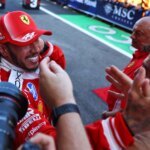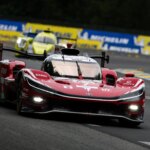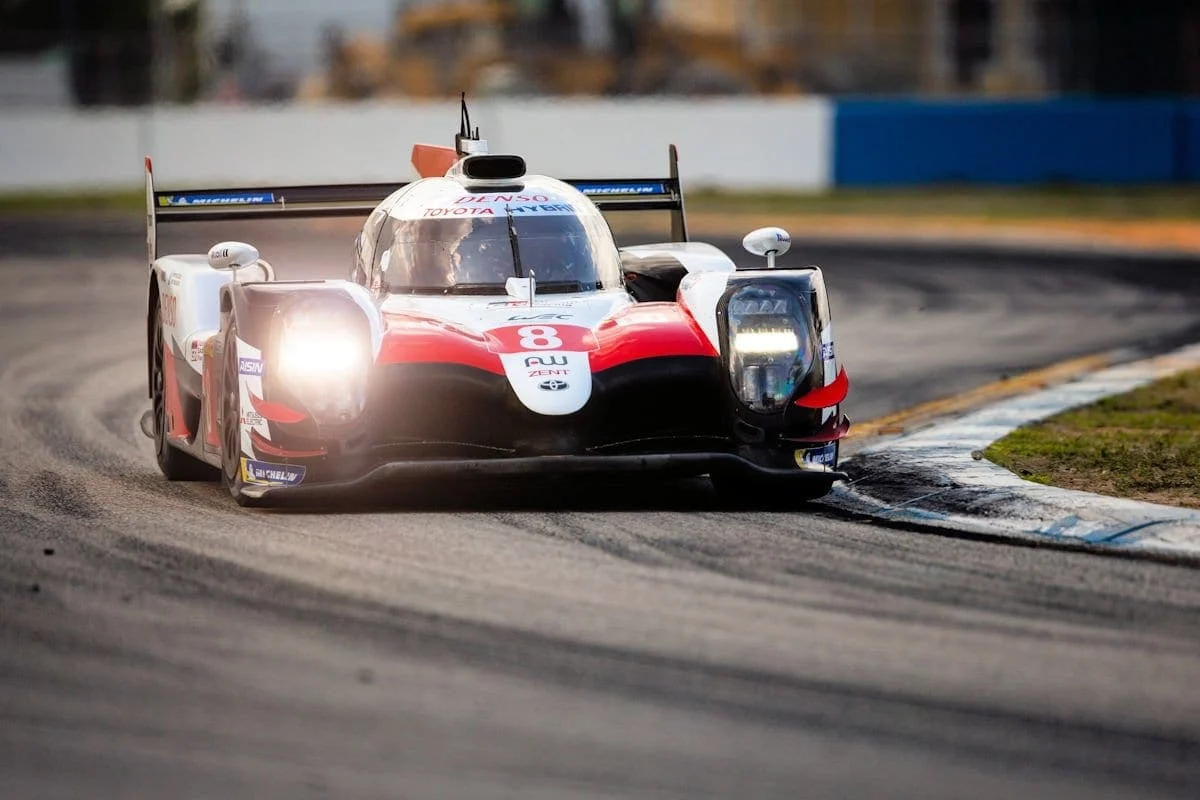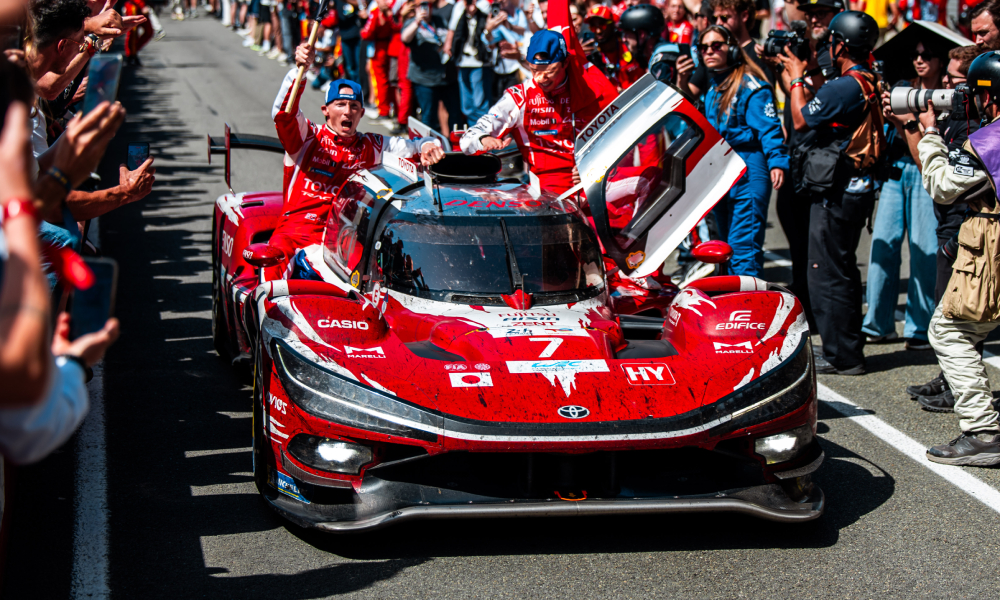
Kamui Kobayashi has revealed the 24 Hours of Le Mans-winning Toyota TR010 Hybrid went into “safe mode” for a portion of the race due to a driveshaft torque sensor problem, which led to the No. 7 crew “giving up” on victory at one stage.
Toyota emerged with a long-awaited sixth victory in the FIA World Endurance Championship blue riband with the car Kobayashi shared with Nyck de Vries and Mike Conway prevailed by just ten seconds over the No. 20 BMW M Hybrid V8.
That was after a troubled opening part of the race as the No. 7 car lost ground with a slow puncture, and then a reduction in performance owing to a problem with a driveshaft torque sensor that forced a switch to an engine mode with less power.
However, those issues didn’t prevent Kobayashi and Conway sealing their second wins at Le Mans, after their 2021 success, and de Vries his first.
“We were always chasing back to the head of group a little bit,” Kobayashi told reporters post-race. “We were further down because we had the slow puncture.
“There were a few safety cars that bunched us up and brought us back positions, and we started really to push in the last five, six hours because [until that point] we were trying to save the car.
“We had a driveshaft sensor problem; we had to drive in a back-up mode, which is not optimal. We had to drive in safe mode with less power.
“At one point we were giving up and we were just trying to finish the race. When we drove, we avoided the curbs and everything and somehow we came back a bit better in terms of engine performance, and that brought us a little hope.”
Toyota Racing technical director David Floury said the sensor issue began to manifest itself five hours into the race, but that a combination of the problem improving on its own and the drivers taking extra care allowed the team to mitigate the situation.
“The sensor was not gone completely, but it was drifting, and it messed up the measurements,” explained Floury post-race.
“We had to go into default mode, but then the sensor came back and even when the sensor was back we were triggering a lot of illegal [power spikes], so we had to reduce the power. During some periods we had 6-8 km/h difference between the two cars.
“Luckily the sensor decided to partially come back, and by analyzing the data, we identified some patterns that were triggering the default, so we briefed the drivers to avoid these specific conditions.
“We managed to survive with decent power with the remainder of the race. It was a bit up and down, not consistent.”
Victory for the No. 7 crew was Toyota’s first since the 2022 edition that marked its fifth win in succession.
However, Kobayashi admitted that the win was the hardest and the one likely to be treated with most respect externally due to the much greater depth in competition in the top class compared to the previous time the Japanese marque won.
“I think this is one of the highest because we had so much competition,” said Kobayashi when asked to rank Toyota’s 2026 win against its earlier ones.
“It’s different timing [compared to Toyota’s earlier wins], but with Hypercar and BoP, it’s so difficult to win now.
”We had five wins in a row in LMP1 and less manufacturer teams, and now we have proper teams, everyone has experience now.
“It’s very challenging for everyone, but it has been a huge effort from all the team, and from Japan.”
Hirakawa: “Mixed Feelings” to Lose Out to No. 7 Crew
Toyota ended up with two cars on the podium as the No. 8 car driven by Sebastien Buemi, Brendon Hartley and Ryo Hirakawa ended up finishing third behind the No. 20 BMW M Hybrid V8 that provided the manufacturer’s stiffest opposition.
For much of the race, the No. 8 car appeared to be the better-placed of the two Toyotas until it was jumped by the sister car in the closing stages as the team split strategies.
It followed the No. 7 car being forced into the pits under full course yellow for emergency service while de Vries at the wheel, after which the Dutch driver was short-fuelled at this next stop to gain track position over the No. 20 BMW.
Buemi then proceeded to stay out on triple-stinted tires to gain the advantage over the BMW, and proceeded to hold up his opposite number in the No. 20 car, Robin Frijns, to allow the No. 7, now with Kobayashi at the wheel to extend its lead.
Hirakawa, who ended up with the fastest lap of the race, admitted to some frustration at how the closing stages played out but said the team did the right thing.
“We had two cars fighting for victory and we split the strategy,” he told Sportscar365. “In the end we lost by 20 seconds. Of course I am a bit jealous.
“But finally we fought for the team. We kept the same tires on the penultimate stint to create a gap to car No. 20, and it worked out, because car No. 7 had enough of a gap to car No. 20. We did the right thing for the team.
“We fought as a team. Only one car can win. Both cars cannot win. It’s mixed feelings. As a driver, I felt I did my best. I couldn’t have done more.
“At least we got on the podium, and we need to celebrate for car No. 7.”