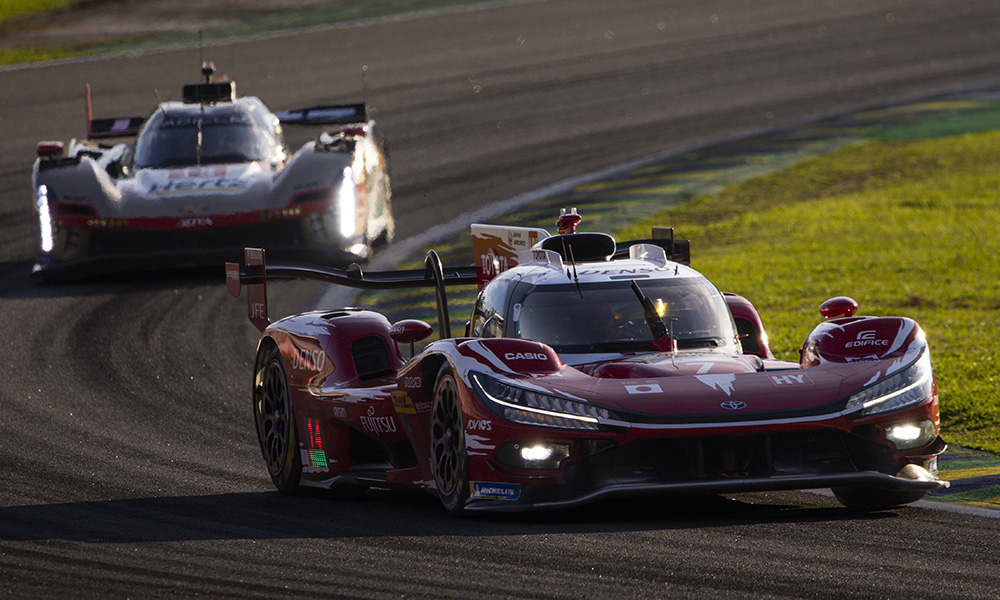
In the forthcoming 6 Hours of Circuit of The Americas, Hypercar squads will operate with shorter stint lengths, a shift that Brendon Hartley of Toyota Racing says will alter the approach “considerably.”
Sportscar365 has learned that every Hypercar will carry a reduced maximum stint energy compared with earlier FIA World Endurance Championship events this season, to the point where a seventh pit stop will be required in the race.
Toyota Racing’s technical director, David Floury, told Sportscar365 that the reduction sits in the vicinity of 10-15 percent and is applied uniformly across the field.
Hartley indicated that the change will translate into roughly three to four fewer laps per stint for all entrants compared with last year’s event.
“Everyone has far less energy than in previous races, which means the stints will be noticeably shorter, simply due to the regulation,” Hartley told Sportscar365.
“It’s significant because instead of a clearly defined six-stint race, you’ll suddenly see close to seven stints.
“It shifts the strategy quite a lot. It forces more double-stints on tires, even if the runs are shorter.”
“It’s not just affecting us; it changes how the strategy is laid out, including when you pit drivers and how you manage tires.”
“That’s going to be something interesting and something to monitor over the weekend.”
Cadillac Hertz Team JOTA’s Jack Aitken believes the change will deliver a much more strategic contest, with multiple options now on the table.
He told Sportscar365: “You can slot that short stint anywhere. You can use it at the start to gain clean air. We’ve seen that a few times already this year.”
“You can weave it into the middle of the race as well. It’s just going to be a bit tougher this week because, as some teams have noted, it’s hot, so you won’t see the typical Driver 1 double, Driver 2 double, Driver 3 double pattern.”
“You’re probably going to see many more single-stint drives. It’s tricky if you end up on someone else’s tires.”
“If Earl [Bamber] starts with a double and I jump in on his tires, it’s a bit of a challenge because you don’t really know the history of that particular set.”
“The combination of those two factors opens up a lot of possibilities, which is quite fascinating.”
“I think we’ll need to get on track tomorrow and just see how it plays out.”
While the FIA or ACO have not yet disclosed a reason for the adjustment, Aitken said he suspects the move is intended to separate Hypercar and LMGT3 stint lengths, which were set to overlap this weekend on the 20-turn, 3.426-mile circuit.
“I believe it’s the right call to reduce the stint energy to prevent a congestion in the pits because we were going to overlap quite a bit with the LMGT3 field,” he commented.
“So there would have been a lot of stops happening simultaneously. This should avoid that chaos and won’t interfere with each other’s races.”
“It will help with the heat during stints, and it should make the race more intriguing from a strategic standpoint because you can work with that shorter stint.”
Floury of Toyota, noting that the energy allocation has fallen from around 900 MJ to just under 800 MJ, said the team is aiming to make the best of the situation.
“It doesn’t overcomplicate things; it simply means shorter stints and more of them with the same number of tires,” he said.
“It will shift the overall picture somewhat. Normally it would have been a bit under six stints, and now we’re likely looking at close to seven.”
“At the end of the day, the change affects everyone equally, so it isn’t a game-changer.”
Stephen Lickorish contributed to this report