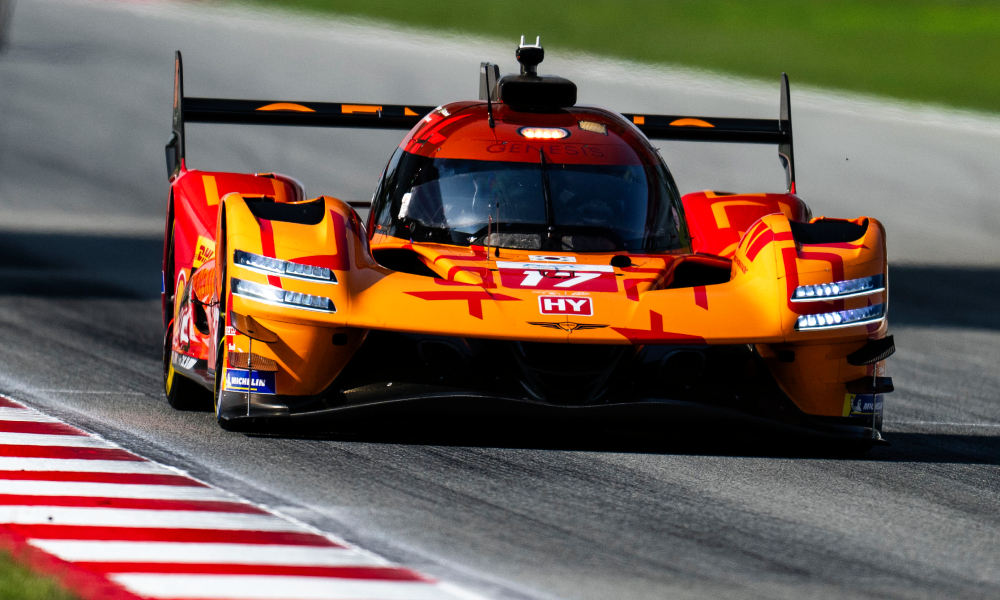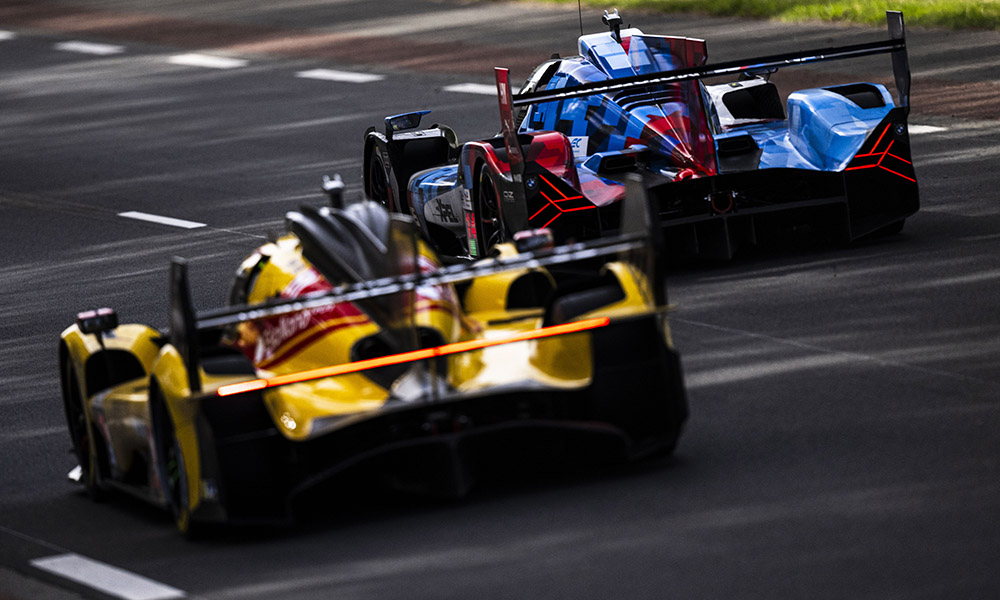
Many of the current and upcoming manufacturers involved in the premier level of prototype racing across the FIA World Endurance Championship and the IMSA WeatherTech SportsCar Championship have expressed broad approval for the recently disclosed 2030 regulations framework.
Unveiled at the annual ACO press conference in Le Mans earlier this month, the core elements of the rulebook remain in draft form and are not anticipated to receive formal approval from the FIA World Motor Sport Council before the end of the year at the earliest.
Nevertheless, after canvassing more than half a dozen OEMs, nearly all of them, with Toyota as the notable exception, reacted positively to the prospect of a unified, single technical regulatory package that would replace the current split between LMH and LMDh machinery.
“For me, it’s moving in the right direction,” said Andreas Roos, head of BMW M Motorsport, speaking to Sportscar365.
“We required one technical framework for the future, one convergence that would allow us to develop cars under the same rules and bring the teams closer together.
“The framework itself appears to be exactly what we need, and now it’s down to the technical working groups and the specialists defining the individual elements of the regulations.”
“Also crucial is keeping costs under control and ensuring the rules are sustainable over time so endurance racing can endure for many seasons to come.”
The proposed regulations would enable manufacturers to construct cars that resemble today’s LMDh entries, featuring a chassis from one of four authorized constructors and the option to select a readily available hybrid system, or to develop the entire vehicle in-house, provided it adheres to the same chassis rules and power limits as its counterparts.
This represents a major shift away from the current LMH regime, which permits four-wheel-drive configurations with bespoke front-axle hybrids and grants more design freedom than the LMDh framework currently allows.
While Ferrari chose not to comment when contacted by Sportscar365, other LMH manufacturers Aston Martin and Peugeot remained optimistic about the future prospects, even if it means building new cars from the ground up.
“We fully support the new regulations that the FIA, ACO and IMSA have introduced, but it will be a new platform for us, so we must evaluate the technical requirements carefully,” stated Aston Martin’s Head of Endurance Motorsport Adam Carter.
“We would, of course, like to be part of it beyond 2030. It was a strong announcement, but we also need to see more detail to formulate a strategy and ensure Aston Martin’s ethos is reflected within the rules.”
Olivier Jansonnie, Head of Stellantis Motorsport, added: “Clearly every manufacturer has its own view. The supply model offers a good level of flexibility, allowing us to decide whether to build our own car.”
McLaren and Ford, both of which will join the WEC Hypercar grid next year with LMDh-based machines, have voiced their support as well.
“We came in with the [LMDh] regulations and still believe they strike a very nice balance for the future,” commented James Barclay, McLaren’s Endurance executive director, to Sportscar365.
“We must be careful not to create a category that is merely dictated by the size of the budget available. That’s vital to us, and the direction we see is about preserving the core ingredients that have worked so far while ensuring we don’t accelerate costs that don’t contribute to the spectacle.”
Ford Racing’s global director Mark Rushbrook added: “This is the right framework to sustain convergence.”
“The current setup works, but I believe it will work even better if there is deeper convergence under a single rulebook, bringing the cars even closer in architecture and engineering. That should benefit racing for everyone.”
When asked which route they would pursue if their programs extend to 2030, BMW, Ford and McLaren would likely remain with a constructor-supplied chassis and the off-the-shelf hybrids, whereas Aston Martin and Peugeot would have to design cars from scratch.
LMDh Upgradability, Size of Hybrid Powertrain Still Question Marks
Several aspects remain to be fully defined or are the subject of debate among OEMs.
One key question concerns the upgradability of existing LMDh cars. IMSA president John Doonan indicated upgrades would be possible, provided they comply with FIA’s new safety cell standards and the prescribed underfloor and diffuser constraints, which aim to reduce the aerodynamic envelope across the field.
“There will surely be updates, but the objective is to keep as many carry-over parts from the current car as feasible,” Roos explained. “That would enable every LMDh manufacturer to keep operating within current budget frameworks.”
Porsche Motorsport chief Thomas Laudenbach noted that “significant elements” could be carried over on cost grounds.
“I’d expect you could retain a certain portion,” he said. “On the other hand, if there’s a genuine opportunity to build a new car, you might choose to do so based on what you’ve learned.”
Roos suggested a modest enlargement of the currently Bosch-supplied electric motor and Fortescue Zero (formerly Williams Advanced Engineering) battery could be explored.
Electric motor and battery capacities were not disclosed at the launch event.
“This deserves study because the hybrid system was already in development around 2021–22,” Roos noted. “Since then, the automotive sector has evolved significantly in terms of electrification.”
“If there are feasible paths to take a next step, we should explore them; however, it isn’t a racing-essential requirement.”
Jansonnie added: “We currently have two platforms. It’s likely we’ll land somewhere in between in terms of hybrid energy, but the exact position remains to be determined.”
“The emphasis on cost from the outset is positive. It’s crucial to maintain control over expenses.”
“Now we must analyze where technology can be applied while keeping costs firmly in check.”
“There is probably room to increase the amount of electrical energy compared with the current LMDh.”
Mixed Feelings on Evo Joker Elimination
Laudenbach, who suggested the new regulations will influence Porsche’s possible return to the WEC Hypercar in 2030, also believes that Evo jokers should remain, which contradicts the framework introduced earlier this month that there would be no “performance evolution” allowed for at least five years, with only safety or reliability updates, or a “demonstrated significant deficit of performance.”
“I hope this is still a topic for discussion because it helps with cost control,” he said. “On the other hand, the development work beyond the initial car is not a major budget driver.”
“If you build a car and realize after a few races that you don’t have the fastest package, you rely on the sanctioning bodies to fix it,” he argued.
“That’s probably where some thoughts should be given. A manufacturer wants the option to improve things if the initial result isn’t optimal.”
Jansonnie commented: “They should have done this (eliminating jokers) a decade ago. We’ve been pushing for it.”
“Constant development on the cars, regardless of on-track performance, is not what we’re asking for. We’re calling for the opposite.”
Laudenbach proposed adopting a MotoGP-style approach, allowing updates based on race outcomes.
“You would only be permitted to introduce updates when you’re not leading,” he suggested. “That would be limited and controlled.”
Jamie Klein contributed to this report