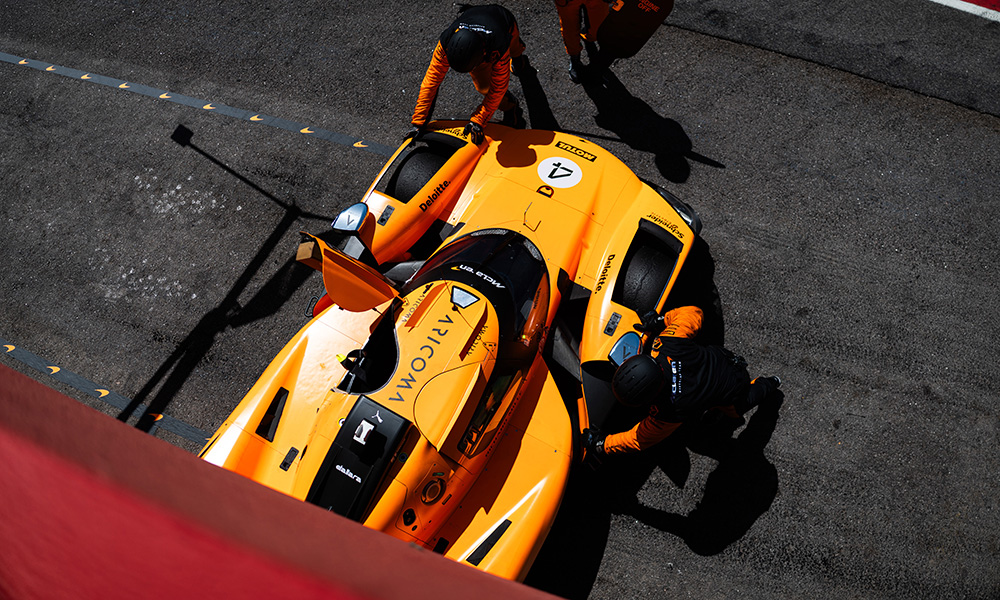
McLaren is transitioning into the next development stage for its MCL-HY prototype after confirming its complete driver roster and vehicle configuration, as disclosed by James Barclay, head of McLaren United AS.
The British marque is preparing for its Hypercar bow in the FIA World Endurance Championship in 2027 and has two testing sessions scheduled before year’s end, one of them at Portimão later this month with all six drivers present.
“Our priority remains advancing the car’s development,” Barclay told journalists at the latest 6 Hours of Monza.
“Now that the lineup is set, the next test onward will be an opportunity to bring all six drivers together.
“That should be an excellent chance to unite the squad; we’ve been anticipating that moment.
“The key thing is the progress made so far in car development and team operations, and it must be continued.
“Bringing all six drivers, across both cars, marks a crucial next phase of our program.”
Although further testing in the early part of next year is planned in the Middle East, Barclay noted they will retain some flexibility depending on regional geopolitics.
“We’re watching how developments unfold at the moment,” he said.
“If we have to adapt, we’ll consider a range of alternative options should the need arise.”
Asked how complete the Dallara-based LMDh is at this point, Barclay indicated they are approaching the final stage of homologation.
“We’re largely there, but development will continue right up to the last possible window,” he said.
Homologation always involves a balance. You don’t want to push it too late: you can pursue performance but at the cost of reliability.
“From our perspective, we’re in the final phases, meticulously finishing off the details.”
“There have been no major changes to the aero package or the powertrain.”
“The focus now is fine-tuning to ensure the desired drivability, completing the aero balance, and nailing those final details.”
To date, McLaren has utilized one development chassis for all testing since the Varano rollout in May, a choice Barclay described as deliberate.
That contrasts with Ford, another 2027 Hypercar debutant, which has conducted tests with two ORECA-chassised LMDh cars but unveiled its car publicly only in August.
“We wanted to validate and finalize before committing to two cars; our belief is that focusing on developing components first is more efficient before expanding to a second car,” Barclay explained.
“Then, once we had clarity and confidence, we could begin producing more parts.”
“I think it also depends on the start time.”
“We began early for that reason; starting later would likely require doubling the effort to accelerate knowledge with two cars operating.”
“It likely varies; a late start might have led to a different strategy.”
Driver Lineups to be Finalized During End-of-Year Testing
Barclay noted that the ultimate pairing for the twin-car program will be decided after the last of the two European tests scheduled this year.
The latest additions to the driver pool are Malthe Jakobsen, Gregoire Saucy and Leonardo Fornaroli, joining Mikkel Jensen, Laurens Vanthoor and Alex Lynn.
“We have a solid sense, but we intend to employ those tests to assign drivers to the respective squads and lock in those decisions,” Barclay said.
Questioned about the possibility of two-driver crews in some six-hour races next year, Barclay played down the idea, particularly ahead of Le Mans.
“I’ve long argued that there are clear benefits to a three-driver arrangement,” he stated.
“Honestly, that’s our default stance as we enter, and we’ll adapt from there.”
“Looking at top rivals, many run three drivers, which I believe fosters consistency.”
“When the annual 24 Hours of Le Mans ramps up, it’s akin to assembling a team of golfers and saying some players can train longer while one trains less, and still expect equal performance.”