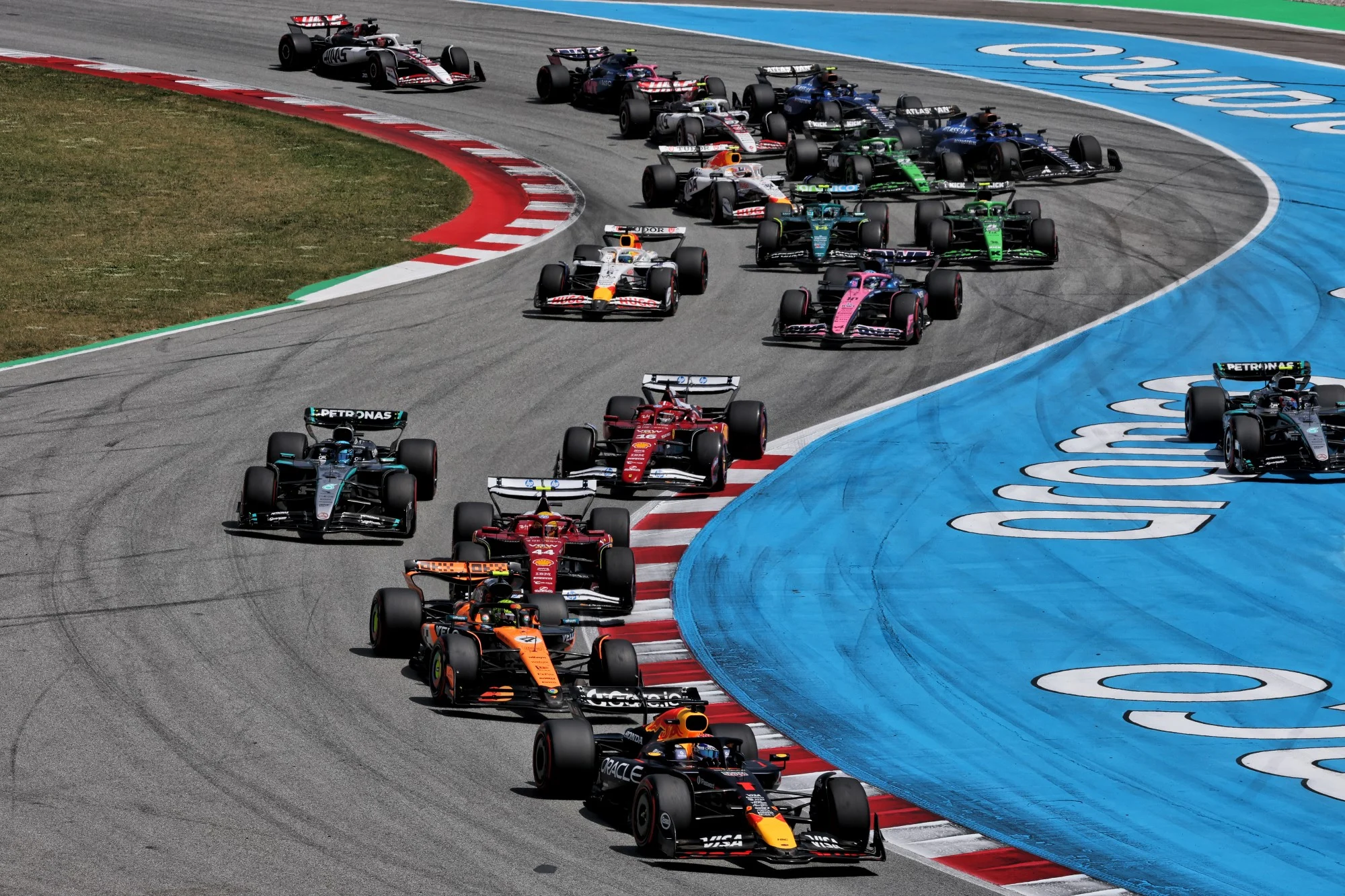
From races held on urban circuits and historic layouts to the Barcelona era and pre-season testing, the Spanish Grand Prix, from this year known as the Barcelona-Catalunya Grand Prix, has followed some of the biggest transformations in Formula 1 over the past decades.
Few races on the Formula 1 calendar have a history so closely linked to the sport’s evolution as the Spanish Grand Prix. Across more than seven decades, the event has moved through different circuits, witnessed profound changes in car technology, and accompanied some of the most iconic eras of world motorsport.
This weekend, Formula 1 returns to the Circuit de Barcelona-Catalunya for another edition of the race, keeping alive a tradition that crosses generations and helped shape the very identity of the sport.
More than a simple round on the calendar, the Spanish GP has become a reflection of Formula 1’s evolution.
A history that began before Formula 1
Spain’s connection to motorsport predates the Formula 1 World Championship itself.
Already in the early decades of the 20th century, the country hosted major international competitions, helping to consolidate a motor racing culture that would later open space for the sport’s flagship category.
When Formula 1 was officially created in 1950, Spain quickly joined the calendar, albeit intermittently during its early years.
Since then, successive generations of drivers have helped write the race’s history.
The many homes of the Spanish GP and the Barcelona-Catalunya debut
Unlike events such as Monza, Silverstone or Monaco, which built their identity at a single venue, the Spanish GP has moved across several circuits throughout its history.
The race was run on historic layouts such as Pedralbes, Jarama, Montjuïc and Jerez before finding its definitive home in Barcelona.
Each of these tracks represented a different phase of Formula 1.
While the early layouts reflected an era of extreme challenges and limited safety, the tracks that followed accompanied the sport’s growing professionalization and the search for more modern structures.
From 2026, the Spanish GP will take place in Madrid, at Madring. This year, the race runs from September 11 to 13.
The arrival in Barcelona
The Circuit de Barcelona-Catalunya hosted its first Formula 1 Grand Prix in 1991.
The shift coincided with a period of transformation for the category, which was entering a new technological and commercial era.
Since then, the Catalan circuit has become a constant presence on the calendar and has taken on a role that goes far beyond simply hosting the race.
Thanks to its technical characteristics, Barcelona became one of the most important tracks for the development of the cars.
For decades, it was also the main site for pre-season testing, further reinforcing its importance within the paddock.
Stage for historic moments
Over the years, the Spanish GP has been the scene of some of Formula 1’s most memorable moments.
It was in Barcelona that Ayrton Senna and Nigel Mansell staged one of the sport’s most famous wheel-to-wheel battles in 1991.
It was also on the Catalan circuit that Michael Schumacher secured some of his most iconic victories and consolidated part of his dominance with Ferrari.
Fernando Alonso lived special moments in front of the Spanish crowd, while newer generations have seen names like Lewis Hamilton, Max Verstappen and Oscar Piastri add their names to the race’s history. Each era of Formula 1 left its mark on Barcelona.
A circuit that grew with the sport
The evolution of the Spanish GP has closely tracked Formula 1’s transformation itself.
The cars have changed radically. Technology has advanced. Safety levels have increased. The championship has become global and has reached markets that once seemed distant. Even so, Barcelona stayed relevant.
Its ability to test different aspects of car performance kept the circuit central within the championship, even with the arrival of new events around the world.
Few tracks have managed to adapt so well to the different phases of modern Formula 1.
The start of a new phase
The 2026 season also marks an important change for the race.
With the Madrid Grand Prix joining the calendar, the Montmeló-held round is officially known as the Barcelona-Catalunya Grand Prix, beginning a new chapter in its history.
Although the name has changed, the essence remains the same. The circuit continues to be one of the sport’s principal technical references and one of the most respected venues by drivers and engineers.