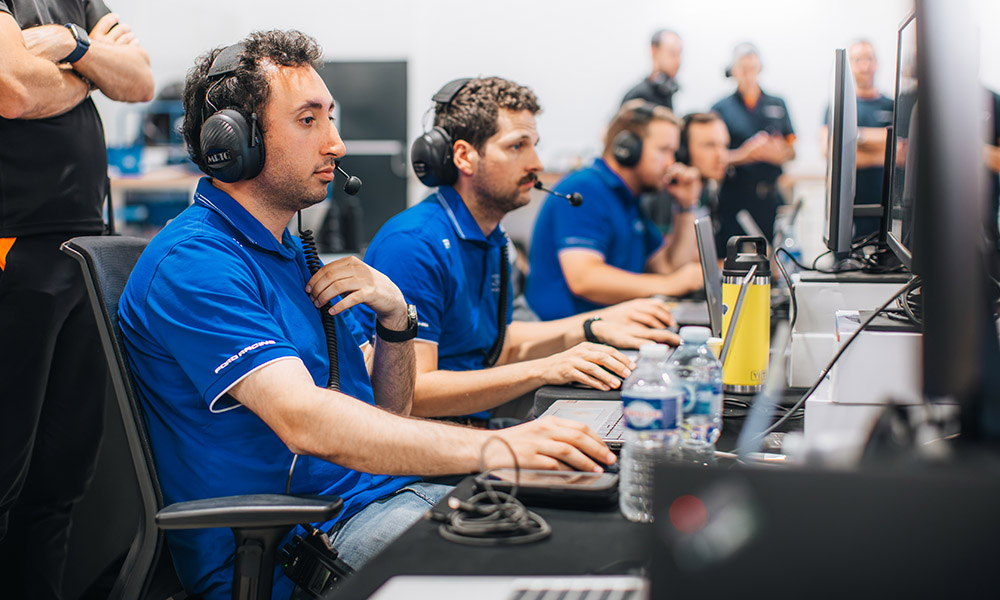
Ford Hypercar program manager Dan Sayers has described ensuring effective communication between the different bases and companies involved in the project around the world as one of the “biggest challenges” in developing the car.
The yet-to-be-named LMDh machine is understood to have recently completed its initial shakedown ahead of the start of on-track testing for its FIA World Endurance Championship debut next year.
The car’s bespoke 5.4-liter Coyote V8 engine has been designed and built at Ford’s global headquarters in Dearborn, Mich., while simulation work has been ongoing at Ford Racing’s technical center in Concord, N.C.
The car itself features an ORECA chassis and it has therefore been constructed at the company’s French facility close to Paul Ricard, while the cars will be run out of Venture Engineering’s UK base in Oxfordshire.
“We have ORECA in the south of France, we have a UK base, we’ve got two U.S. bases, so [it’s about] ensuring that everybody is aligned working on the correct things, the roles and responsibilities and no-one’s overlapping,” said Sayers when asked by Sportscar365 about the challenge of coordinating the project.
“It means I can work longer and harder in a day because I can wake up, do the UK bit and then do the American bit.”
“It is a challenge but everybody’s quite clear — the powertrain and control systems is in the US, so it’s quite defined and actually at the moment it’s quite smooth.”
Sayers said one of his key areas of attention has been “minimizing opportunities for mistakes or errors” between the bases and said “structured integration meetings” when development work on the car first began were vital.
One example Sayers gave of how the different elements are working together concerns testing, where he said that 15 engineers from the U.S. are joining the UK operation to help run the car.
He added that Ford was keen for there to be a strong American spine to the project to help the manufacturer develop in other areas.
“It’s really important to have the engineers from Ford Racing involved in the program because you get to see so much and you do get to learn with the hybrid control systems, there’s a huge amount of learning you can take back to other programs or the production vehicles so that’s a very purposeful move to do more and more in-house,” Sayers explained.
He added that he and the engineers based in Detroit have been in daily contact with ORECA to try to ensure the design process was as smooth as possible.
“The CFD and the aero is being developed with our engineers and development team out in Charlotte,” said Sayers of the ORECA relationship.
“The CFD has been very much a collaboration, which has been really cool to see and it’s another bit of the Ford involvement and they haven’t really had that level of involvement in a car of this scale.”
Sayers also explained that Ford has a completely separate building at ORECA’s facility so there is no overlap with the Alpine, Genesis and Acura brands the French constructor also works with.
“They’re a professional outfit and they’re used to having multiple customers, so everything is divided and separate,” he said.
Once the cars have been assembled there, it is then Ford Racing’s UK operation that will run them at circuits , both in testing and in the WEC next year.
Venture Engineering is an “operational partner” in that entity with Venture staff working alongside Ford Racing U.S. employees.