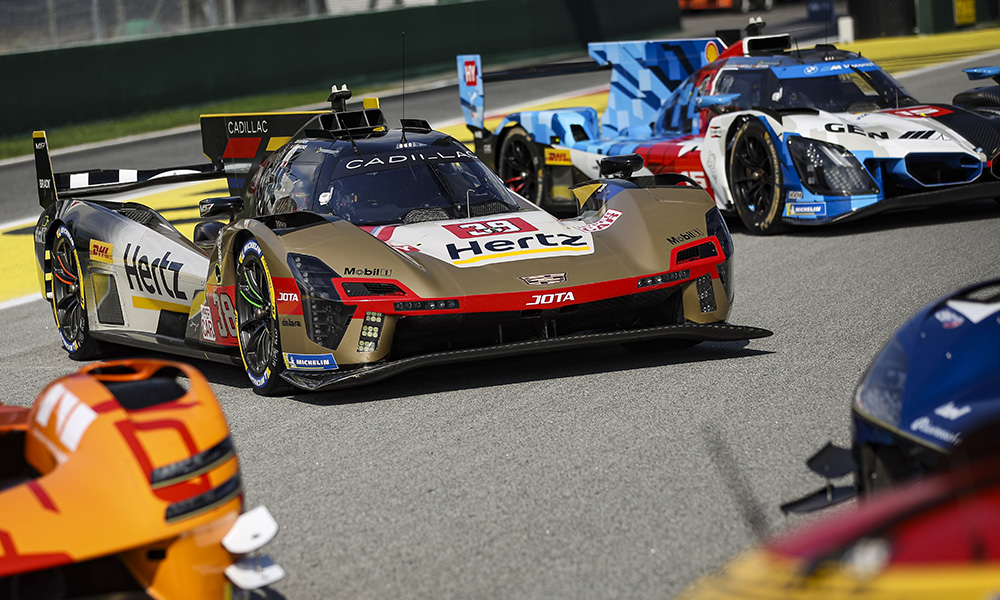
Dallara currently holds the capacity to continue serving as the chassis partner for four manufacturers in the 2030 regulations according to Max Angelelli, who admitted that the finalization of the rules will dictate the exact scope of each constructor’s level of involvement.
The Italian company, which currently works with BMW, Cadillac and McLaren on its LMDh-based prototypes, as well as supplying the chassis for the Ferrari 499P LMH car, has achieved 12 Hypercar wins out of a total of 31 races since the start of convergence in 2023, second only to Toyota.
While it will add a fourth OEM in McLaren beginning next year, Angelelli believes they should be able to maintain the same level of support for 2030, should all four manufacturers elect to continue under the new ruleset, or one is replaced by another brand.
“Capacity for the 2030 cars can be very tricky,” Angelelli told Sportscar365. “It depends on the technical regulations. The level of freedom they’re going to allow will determine the Dallara capacity.”
“From what we know today, yes, no problem, we can serve all four of our [current] customers, in the same top level.
“But I don’t know what’s going to happen in three months. And I don’t know what [direction] our manufacturers would like to head in.”
“It can be tricky. Because unlike in the past, we will have four manufacturers starting the same race at the same time.”
One of the details that still needs to be formalized is the possibility for each OEM to have a unique spine, and not a common spine as is currently the case with each LMDh constructor
“It’s not determined yet,” said Angelelli. “In Le Mans, they said there will be two options. They said unique car or shared.”
“Let’s assume for a second that all four of our customers are going for a unique car. Then we have to build four different cars at the same time.”
“It’s tricky because we don’t know the level of freedom that the technical regulations will allow. But I feel we can do it.”
Angelelli said the other major concern is costs, something that has been echoed by both BMW and newcomer McLaren in recent months, with BMW M Motorsport director Andreas Roos pushing for the 2030 rules to be as close as possible to the current LMDh regulations.
“When this formula was designed just outside of COVID, there was a lot of optimism, a lot of desire to go back to normal life, have fun, etc,” said Angelelli.
“From those days to today, things are different. There are wars, there are crisis.”
“What I’m saying is budget, how much is it going to cost to go racing? That is the most critical piece of the puzzle to keep in mind.”
“Everyone of us have to keep in mind that it cannot be crazy expensive like in the past. It would not work.”
While the draft set of regulations, which were originally due out by the end of this year, have been pushed back to mid next year, Angelelli is still hopeful that the end product will result in a continuation of the current level of participation.
Despite Lamborghini, Alpine and Acura’s withdrawals, there are set to be nine brands in the WEC Hypercar class next year.
“There’s a good level of cooperation,” Angelelli said on the 2030 talks. “Everybody is really working well, from the manufacturers, to the constructors, the governors of convergence.
“We’re trying our best to offer the best show, the best product to the fans. We really care. We as a constructor, we care about the sport and we care for our customers.”