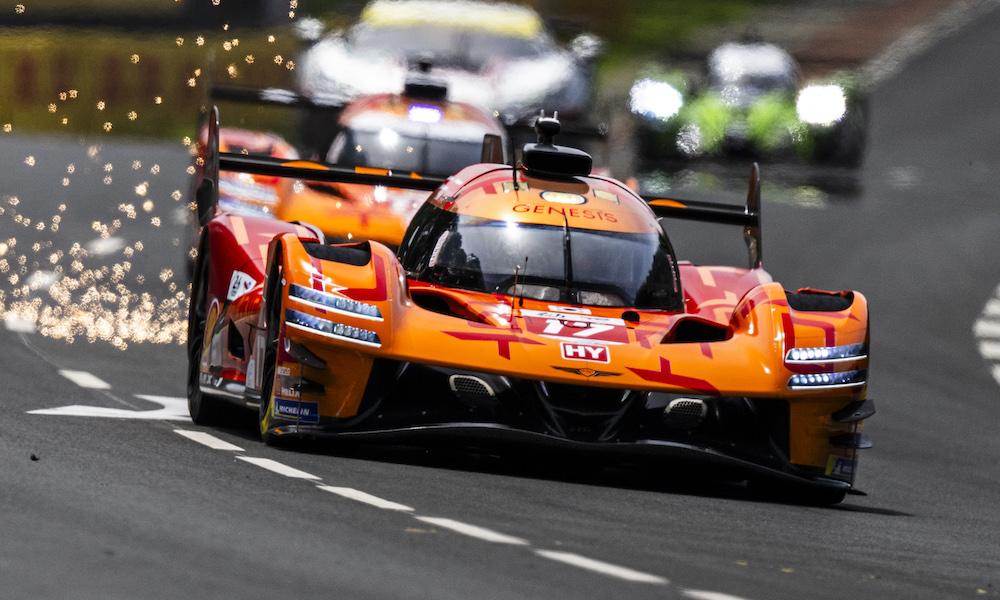
Genesis Magma Racing’s team principal, Cyril Abiteboul, described Le Mans’ 24-hour debut as filled with surprises, including a stretch where the No. 17 machine climbed as high as fourth, while the squad’s main objective had been achieved.
The South Korean marque joined the FIA World Endurance Championship for the first time this season, but its new GMR-001 Hypercar arrived at Le Mans already facing challenges—having skipped the planned ten-hour season-opener in Qatar and carrying questions about reliability.
Nevertheless, Genesis impressed many with its speed at the Circuit de la Sarthe, as the No. 17 car earned a place in Hyperpole 2, while the sister No. 19 remained in the top ten for much of the early race until an electronic fault disrupted its run.
When asked whether he was surprised by the car’s potential, Abiteboul told Sportscar365 that the performance and competitiveness of the package were somewhat unexpected. He noted that the week had shown glimpses of what might be possible in qualifying—moments that hinted at pace—so there was an awareness of potential, but it’s impossible to know exactly where everyone stands until the race unfolds. He added that there was a lot of speculation about who was showing what in qualifying, but one must assume that the true pace reveals itself in the race, which was encouraging to witness. Those moments were very encouraging to see, even though race stops and strategic shifts can cause big swings, especially after a safety car when the field is tightly packed. Still, it was uplifting to observe.
The most challenging moment came when the car had to stop for an electronic issue right after a full-course yellow, precisely when the team believed the strategy would yield benefits and positions. That sudden blackout made the situation particularly tough.
The No. 19 car later encountered another electronics problem during the race, finishing nine laps down but still classified 13th, while the No. 17 sister car retired about two-thirds of the way through due to suspension problems.
Abiteboul argued that reliability was not a major surprise given the program’s youth. He explained that validating a car in 24 hours on a track of Le Mans’ complexity is essentially the only feasible approach at this stage, acknowledging that there are other tracks, such as Sebring, that test endurance cars but were not feasible to include in their schedule. It was clear that the team arrived here somewhat underprepared, although they had done everything in their power to be as prepared as possible.
Nevertheless, despite the gremlins, Abiteboul was pleased to have achieved the team’s target of finishing the race. He noted that finishing was a very ambitious objective given the event’s level, and everything beyond that was a bonus on top of that main goal.
Genesis sporting director Gabriele Tarquini added: “Last year, when we launched this project, we could not have imagined that by our third race we would be scoring points at Spa and completing the 24 Hours of Le Mans.” “That’s fantastic. It’s unbelievable. Even in our wildest dreams, finishing this race would have been hard to imagine.”