BMW M Motorsport chief Andreas Roos asserts that Balance of Performance must remain a foundational pillar of the forthcoming top-tier regulations due by 2030, warning that a unified rulebook could trigger an exodus of manufacturers if the performance-balancing tools are removed.
Roos’ stance follows Ferrari’s endurance chief Antonello Coletta, who argues that BoP should not feature in the 2030 regulations, contending that it would be unnecessary if all cars are certified within a narrower performance window.
The debate over the future rules persists amid ongoing technical working-group discussions between automakers and the governing bodies following last June’s proposal to essentially merge LMH and LMDh into a single platform.
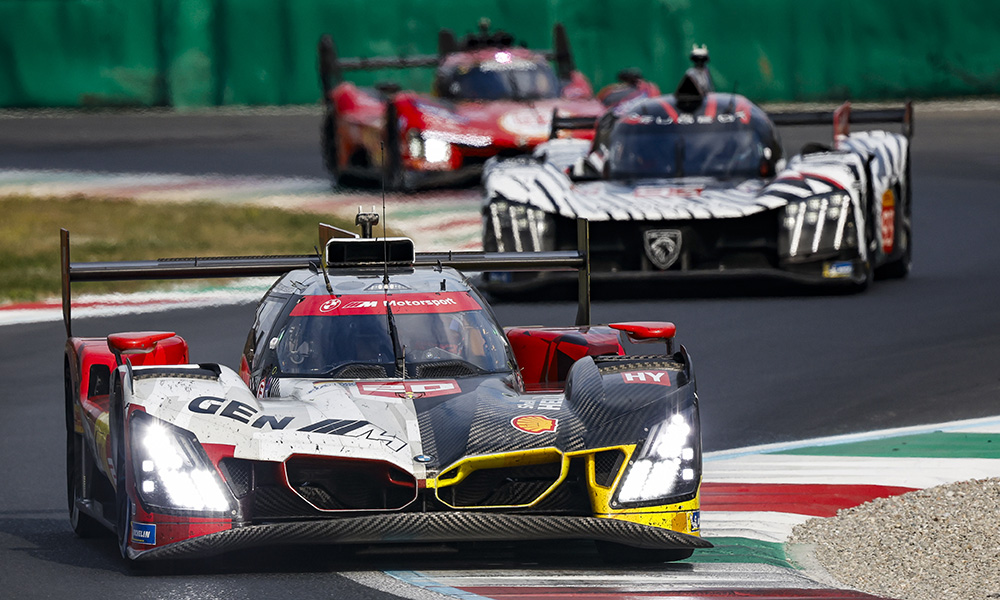
“Clearly BoP, in its entirety, is a foundation and one of the cornerstones of the championship, and that’s what we agreed to when we joined,” Roos told reporters during the World Endurance Championship’s season-closing Six Hours of Monza last weekend.
“I don’t see any justification, nor any chance, to abandon it given the current circumstances.”
“We must keep costs in check. BoP is one of the levers we can use to achieve that.”
“When I read the headlines day after day, the economics aren’t encouraging, and the automotive industry, in particular, is struggling.”
“If BoP were discarded, you would likely see a rise in costs.”
“We’ve witnessed in GT racing that, over time, BoP enables numerous manufacturers and teams across the globe to compete within BoP rules.”
“Here in the WEC, for a fourth consecutive year, BoP has helped maintain a broad manufacturer presence, yielding competitive racing.”
Roos also rejects Coletta’s idea that a four-wheel-drive setup—used by Ferrari, Toyota, and Peugeot on LMH-based prototypes—would inherently be more expensive than the planned shift to rear-wheel-drive hybrids.
“Most of the teams building cars under LMDh regulations operate with a clearly defined cost framework,” he noted.
“The primary components are standardized, and the cars are rear-driven.
“I fail to see why moving away from this configuration would make a four-wheel-drive car cheaper than a rear-wheel-drive one.”
Roos has long advocated for cost containment, or even budget reductions, under a unified regulations regime while preserving the cars’ relevance on track.
“It’s challenging, but we’ve previously operated under open-technology rules in LMP1 and we know how that ended,” he said.
“I don’t think we can afford another episode where the dispute centers on budgets and technical development.”
“Ultimately, motorsport serves as a marketing instrument and a narrative platform.”
“From our perspective, it works well. When we launched, BMW had an XM or an M5 with a V8 hybrid, and our race car runs a V8 hybrid.”
“There are ways to craft compelling storytelling and showcase what the technology can do.”
“Fans on site or watching on television don’t care whether a car edges out its rivals by ten seconds or loses by the same margin—their focus is on exciting, high-quality racing and a grid with multiple manufacturers.”
“In my view, there isn’t a need at this stage for a drastic technical overhaul. I don’t see that as necessary.”
“What matters is ensuring that the technology we deploy has road-relevance.”
“There are series out there that feature impressive tech with little road application, which makes the storytelling aspect difficult.”
Floury: Single Set of Regulations ‘Won’t Solve Everything’
Toyota Racing’s technical director David Floury contends that a single platform alone won’t address the current challenges facing the premier-category, though he backs the FIA, ACO, and IMSA’s drive toward a shared platform.
“There are other aspects to consider beyond the platform itself, and we shouldn’t assume that a single platform will produce exactly identical lap times across the grid or resolve all existing issues,” Floury cautioned. “That would be an erroneous assumption.”
“We are pleased to see a common platform; it makes sense.”
“If we look back, two platforms were necessary because LMH discussions began in 2018 with the aim of a new rule set solely for WEC.”
“Then there was an opportunity to align with the IMSA plans from 2020 onward, initiating the process in early 2020, so two years later than LMH, to define LMDh.”
“There was potential to synchronize both regulations and merge them, even though they remained distinct.”
“The convergence process proved fairly successful, bringing cars from two different regulations onto a common playing field with closely matched performance.”
“You have two distinct rulebooks, yet over time we reduced most of the performance gaps between the top and bottom LMH entries and the top and bottom LMDh cars.”
“That demonstrates that simply imposing a single regulation won’t fix every discrepancy.”
Nevertheless, Floury supports moving ahead with a unified top-class framework.
“The convergence enabled nine manufacturers to be on the grid next year, and that outcome is gratifying,” he noted, adding that this was far more positive than the original three IMSA entrants and three in WEC.
“We must maintain this momentum and ensure a broad cast of manufacturers remain involved.”
“The question now is how best to achieve this with a new, common set of rules that applies equally to all participants.”
“Undoubtedly, a single regulatory framework is advantageous. But it won’t resolve every issue.”