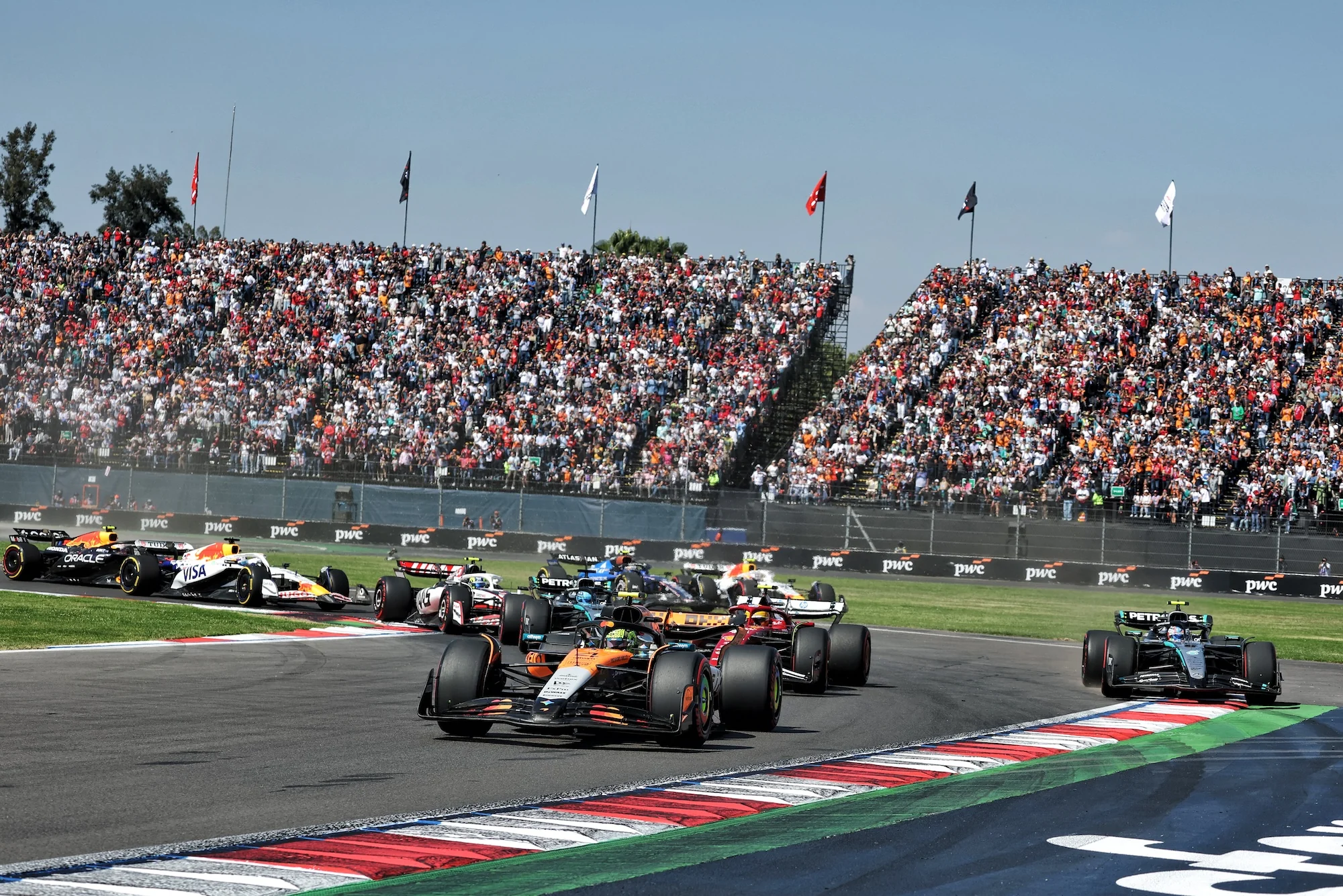
The Autódromo Hermanos Rodríguez sits more than 2,200 meters above sea level and requires teams to adopt specific solutions to face the unique conditions this season
The 2026 Mexico City Grand Prix for Formula 1, scheduled for Sunday, November 1, presents a technical challenge with no direct counterpart among the other rounds on the calendar. Located at roughly 2,240 meters above sea level, the Autódromo Hermanos Rodríguez subjects the cars to atmospheric conditions very different from those experienced at most circuits, affecting aerodynamics, cooling, and the power unit’s operation.
The principal factor behind these differences is the thinner air density. At high altitudes, atmospheric pressure drops, reducing the number of air molecules available in a given volume. For a Formula 1 car, this trait simultaneously modifies the generation of aerodynamic load, drag, and the ability to dissipate heat.
The result is a rather unusual combination: cars can reach high speeds on the straights, but face additional challenges in maintaining grip through corners and in managing the temperatures of their components.
Less air means less aerodynamic load

The wings and the floor of Formula 1 cars rely on airflow to generate aerodynamic forces that increase the grip of the tires on the asphalt.
When the air density decreases, these forces are reduced as well, assuming the same speed and configuration.
In Mexico, this means that a setup capable of generating high aerodynamic load at a sea-level circuit may yield different results.
To compensate for part of this loss, teams can use adjustments that favor load generation. However, the lower air density also reduces drag, allowing high speeds even with relatively loaded aerodynamic configurations.
This relationship makes the Hermanos Rodríguez a peculiar circuit. Engineers must find a balance that preserves stability in corners without compromising efficiency on the straights.
The task is especially important in the sequence of medium- and low-speed corners, where loss of grip can compromise the ability to accelerate and maintain pace.
Cooling becomes a concern
While the lower air density offers advantages related to aerodynamic drag, it also makes cooling of the components more difficult.
Cooling systems rely on air flowing through radiators and other heat exchangers. With less air mass available to absorb and transport heat energy, the efficiency of the process can diminish.
This requires special attention to the temperatures of the power unit, electrical systems, and other components.
Teams may need to modify cooling openings and adjust operating procedures to keep temperatures within acceptable limits.
However, increasing cooling openings can also affect aerodynamic efficiency, creating another trade-off between performance and reliability.
The situation is particularly relevant in 2026, a season marked by a new generation of power units, with a greater share of electric energy in propulsion.
Although engines are turbocharged and equipped with management systems capable of compensating part of the altitude effects, this does not eliminate the thermal and operational demands imposed by the environment.
Brake systems also require attention
Brake systems face a similar challenge.
During intense braking, a large portion of the car’s kinetic energy must be dissipated or recovered, depending on how the systems involved operate.
The lower air density makes it harder to remove heat from the components, requiring attention to the temperatures of the discs and other elements of the system.
Hermanos Rodríguez features important braking points, especially at the end of the long main straight, before the first corner.
The combination of high speeds and reduced cooling capacity makes this stretch particularly demanding.
Engineers must find solutions that allow braking efficiency to be maintained without causing excessive temperatures.
Mexico requires specific preparation
The circuit’s characteristics also influence tire behavior.
The reduction in available aerodynamic load can alter the car’s balance and promote sliding, increasing the demand on the tire compounds.
At the same time, track temperature and grip conditions can modify the speed at which the tires reach their ideal operating range.
Therefore, preparing for Mexico isn’t just about selecting an appropriate aerodynamic setup. Teams must consider the whole package formed by the power unit, cooling, brakes, suspension, and tires.
The three free practice sessions will be important to verify whether the planned solutions work under real circuit conditions.
The Mexico City Grand Prix demonstrates how Formula 1 requires constant adaptations. Even when a car delivers excellent performance at other events, altitude can modify its competitiveness.
At the Hermanos Rodríguez, merely finding speed won’t be enough. Teams will need to ensure their cars can maintain performance and reliability over the 71 laps of the race.