The team turned the regulation change into eight wins and ten pole positions across 11 Grands Prix, but the approach of Ferrari, McLaren, and Red Bull before the holidays shows that the advantage built at the start of the year has already begun to be pressured.
Mercedes arrived at the 2026 Formula 1 summer break occupying exactly the position that major regulatory changes typically offer as an opportunity: the chance for a team to understand the new generation before its rivals.
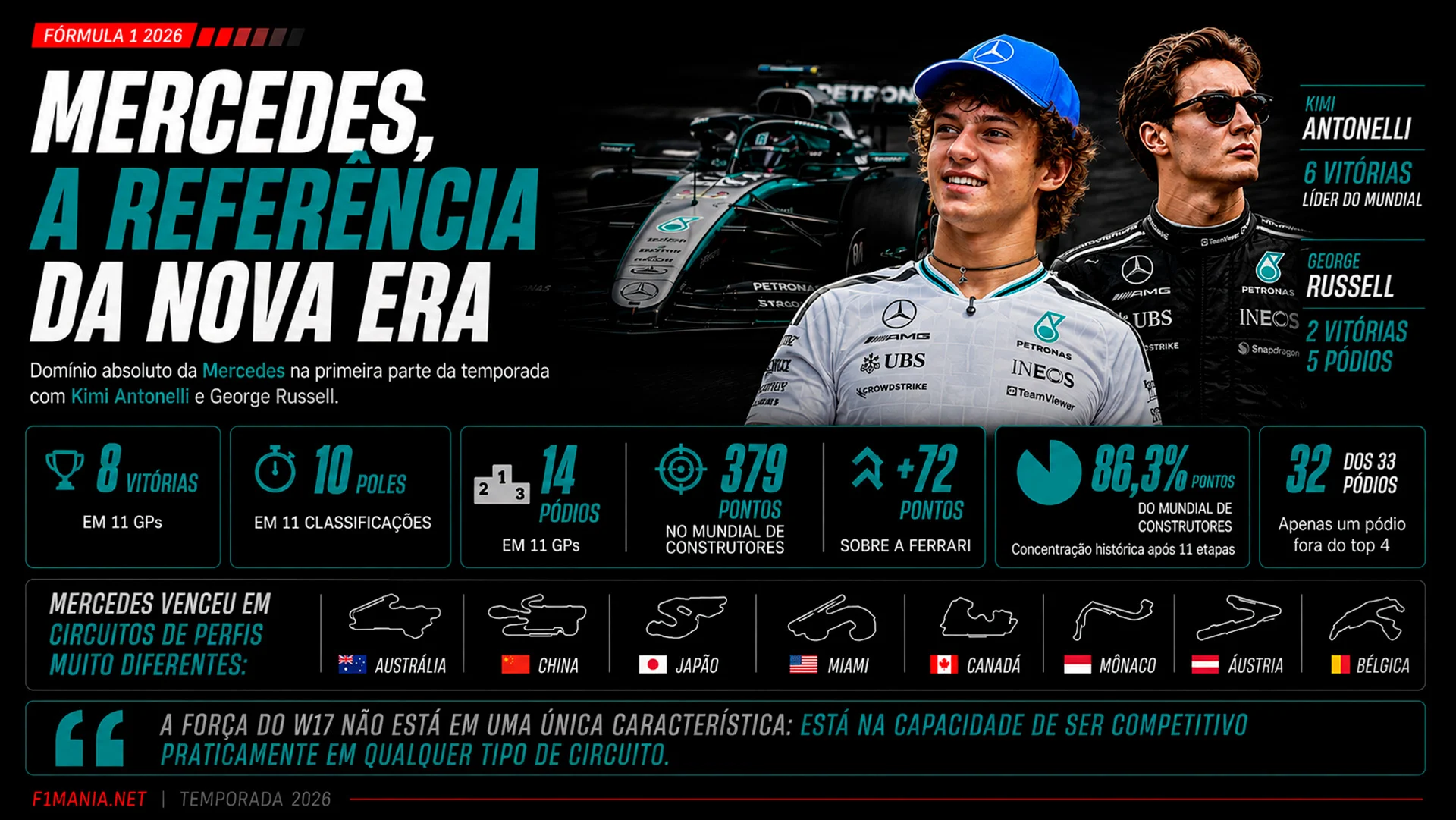
After 11 Grands Prix, there are eight wins, 14 podiums and ten pole positions. Kimi Antonelli leads the Drivers’ World Championship with 219 points, George Russell sits third with 160, and the team leads the Constructors’ standings with 379 points, 72 ahead of Ferrari. McLaren, with 220, and Red Bull, with 177, are still farther back.
But the numbers tell only part of the story. The main hallmark of Mercedes in the first half might not be a superb edge in a single area. It is, in fact, the opposite: the W17 managed to be competitive across very different types of circuits, with two drivers able to exploit its characteristics and a power unit that started the new cycle in a position of reference.
That explains why Mercedes wasn’t simply fast in 2026. It has been, until now, the most difficult team to push out of its window of competitiveness.

From Australia to Monaco, a sequence that defined the championship
The magnitude of the initial advantage showed up as early as Melbourne.
George Russell put the W17 on pole for the season opener with a time of 1:18.518. Antonelli claimed the front row, while Isack Hadjar, third with Red Bull, was 0.785 seconds behind Russell. In the race, although Charles Leclerc took the lead early on, Mercedes benefited from a Virtual Safety Car period to pit both of its drivers and executed a one-stop strategy that finished with Russell first and Antonelli second.
It wasn’t an isolated episode.
Antonelli won in China, Japan, Miami, Canada and Monaco. Thus, the first six rounds of the season ended with a Mercedes in the top spot: one win for Russell and five in a row for the Italian.
The variety of circuits is crucial to understanding the scale of the feat.
Suzuka demands aerodynamic stability and confidence in high-speed corners. Miami blends high-speed sections with slow corners and strong traction zones. Montreal rewards braking, energy efficiency and recovery. Monaco represents almost the polar opposite of tracks like Melbourne and Japan, with low speed, the need for mechanical grip and enormous importance of driver confidence.
The Mercedes won on all of them.
That is where one of the strongest arguments for considering the W17 the most complete car of the first half of 2026 emerges. There was no clear track profile during that initial period in which the team simply ceased to function.
The technical reading of the start of the season also indicated that the advantage was not exclusively in the power unit. Mercedes showed particularly efficient use of electrical energy and less power loss at the end of straights, but the chassis behavior allowed sustaining an energy-recovery approach without sacrificing excessive corner speed. The car’s balance emerged, therefore, as a fundamental part of the whole package.
This is especially relevant with the 2026 regulations. The electrical power of the MGU-K rose from 120 kW to 350 kW, and energy management began to have a much larger influence on lap times. Being competitive stopped being about just generating aero load or power: it also required all those elements to work in an integrated manner.
Mercedes seems to have started this process several steps ahead.
Andrew Shovlin revealed before the season that work on the new power unit had begun years earlier and described the 2026 project as the largest ever undertaken by the team. The simultaneous development between Brackley, responsible for the car, and Brixworth, where the power unit is produced, also gave Mercedes the ability to design both sides of the package in an integrated way.
But the championship showed that this advantage did not stay frozen in March.
Ten poles in 11 GPs show where Mercedes was most dominant
If there is a statistic that best sums up Mercedes’ superiority, it isn’t even in the races.
It’s in the qualifying sessions.
The team took the first ten pole positions of the season. Russell started from pole in Australia, Canada, Barcelona, and Austria. Antonelli held the pole in China, Japan, Miami, Monaco, Britain, and Belgium. Only in Hungary, the 11th round of the championship, did another team finally break the sequence, with Lando Norris taking McLaren to pole.
Antonelli ended the first half with six poles and Russell with four. In the races, the Italian amassed six wins and nine podiums, while the Briton secured two wins and five podiums.
This dominance on Saturdays feeds into a Sunday advantage. Starting from the front allows better control of energy use, avoids the wake of other cars, enables strategic choices without constant reacting, and reduces exposure to incidents in the pack.
There were also races where the team had to manage less favorable circumstances. In Australia, the Virtual Safety Car read helped Russell and Antonelli regain control after Ferrari’s early lead. In Austria, Russell converted pole to win despite late pressure from Verstappen. And in Hungary, Antonelli started seventh after a penalty, adopted a different strategy and fought back to finish third.
The ability to deliver results even when the weekend doesn’t go as planned helps explain why the lead is so comfortable.
Still, it would be wrong to describe Mercedes as a flawless execution machine.
Reliability is the main point that prevents an even more dominant campaign
The results could have been even better.
Mercedes has three retirements in the first 11 Grands Prix. Russell suffered two and Antonelli one.
The most obvious case happened in Canada. Russell was involved in the battle for the lead with Antonelli when he retired on lap 30 due to a power unit issue. The Italian went on to win.
In Barcelona, Antonelli also lost a crucial result. He had just overtaken Russell and was on course for second place when a mechanical failure ended his race.
Silverstone also brought problems without an official retirement. Antonelli was contesting the front positions when a failure in the left-front wheel shield required extra pit stops and completely compromised his race. He finished 15th.
Reliability, therefore, represents an important nuance. Mercedes has the most successful car in the championship, but not necessarily the most robust package every weekend.
That also explains part of the gap between Antonelli and Russell in the World Championship.
Antonelli turned speed into leadership; Russell kept Mercedes strong across both cars
The start of 2026 transformed Antonelli from a promise into a legitimate title contender.
After second in Australia, the Italian won five races in a row between China and Monaco. The retirement in Barcelona interrupted the streak, but he returned to the podium in Austria and, after a complicated weekend at Silverstone, won again in Spa. The third place in Hungary took Antonelli into the holidays with 219 points and a 50-point lead over Hamilton, his closest rival.
There is a particularly important feature in this campaign: Antonelli capitalized on the phase when Mercedes was clearly superior.
When there was a car to beat, he beat it.
That may seem obvious, but it is exactly the kind of efficiency that turns technical advantage into championship lead.
Russell had a different season. He won immediately in Australia, stayed close to Antonelli during the early phase and won again in Austria. He also claimed two Sprint races and arrives at the break with 160 points, despite retirements in Canada and Spa.
The presence of both drivers in the lead positions also differentiates Mercedes from some rivals. There is no dependence on a single car to produce big results. Of the team’s 14 podiums in F1 races, nine belong to Antonelli and five to Russell.
This balance proved especially valuable in the Constructors’ Championship.
Even when one driver hit trouble, the other often stayed in the hunt for important positions. It was Antonelli who won after Russell’s retirement in Canada; when Antonelli retired in Barcelona, Russell finished second; and in Austria the two finished on the podium.
It is one of the reasons Mercedes managed to reach 379 points even without a flawless campaign.
Rival development changed the picture before the holidays
However, there is a fairly clear split in Mercedes’ season.
In the first six races, the team won six times.
In the following five, it won only twice.
Hamilton won with Ferrari in Barcelona. Russell answered in Austria. Leclerc won at Silverstone. Antonelli returned to the top in Spa. And Norris ended the first half giving McLaren its first win of the year in Hungary.
In other words: Mercedes won 100% of the first six events and only 40% of the following five.
It doesn’t mean the W17 suddenly ceased to be the best car. It means the margin for rivals to react broadened.
Mercedes itself acknowledged this before Hungary. Technical Director Resta stated that Ferrari had been gradually reducing the gap and revealed the team was preparing a more significant update package for after the holidays.
Antonelli came to a similar conclusion after the Budapest classifications, noting that Ferrari and McLaren had progressed in development. For the first time in 2026, no Mercedes claimed pole.
Ferrari currently represents the most consistent threat. Despite not taking any poles, it won in Barcelona and Silverstone, accrued nine podiums and has 307 points. Hamilton sits second among drivers and Leclerc fourth.
McLaren showed peaks at different times. It had been particularly strong in Miami, placing Norris and Piastri on the podium behind Antonelli, but turned its progress into a complete result in Hungary: Norris took the first non-Mercedes pole of the year and won the race.
Red Bull has yet to win in 2026, but Verstappen closed in on Russell in Austria, finished third in Spa, and was second in Hungary. The team reaches the holidays in fourth in the championship, but its recent results show there are circuits where the RB22 can pressure Mercedes.
The threat, therefore, does not always come from the same direction.
In certain tracks it is Ferrari. In others, McLaren. Verstappen can also bring Red Bull into contention in specific circumstances.
The difference is that, so far, none of them have demonstrated the same width of performance across 11 rounds as Mercedes.
After all, is it the best car or the team that executes the best?
Results from the first half suggest that separating these two things completely would be artificial.
Mercedes likely has the best car in Formula 1 in 2026 so far. Ten poles in 11 qualifying sessions are a particularly hard evidence to explain solely by strategy or execution. The W17 showed speed on fast, slow, permanent, and street circuits. There is also evidence of an initial advantage in the power unit’s operation and energy management, accompanied by a chassis balanced enough to exploit that trait.
But owning the best car does not alone explain an eight-win campaign.
Antonelli turned six chances into wins and built a 50-point lead in the World Championship. Russell won two others, collected five podiums and kept the second car regularly among the front runners. Mercedes also managed to respond strategically when races demanded different decisions, such as at the start of the season and again in Hungary.
The answer, therefore, isn’t about choosing between car and execution.
The strength of Mercedes lies precisely in the combination.
The W17 began 2026 as the reference package; the power unit provided a competitive base for a much more energy-management-dependent Formula 1; the car managed to function on tracks with radically different characteristics; and Antonelli and Russell converted that advantage into points.
That is what differentiates Mercedes from its pursuers.
Ferrari has already proven it can beat it. McLaren has already managed to outperform it in qualifying and racing in the same weekend. Verstappen has already managed to bring Red Bull into the fight.
None of them, however, has yet shown that they can do so on almost every circuit.
After 11 rounds, perhaps the most precise definition of Mercedes’ advantage is not that it is unbeatable on all tracks, but that it arrives at almost all of them with some way to win.
The first half of 2026 showed that this was enough to build a substantial lead.
The recent races also showed that it might not be enough to maintain it unchallenged in the second half.