Ferrari has highlighted the extra costs and efforts involved in crafting two separate logistical plans in light of ongoing uncertainty surrounding the FIA World Endurance Championship schedule.
The conflict in the Middle East had already compelled organizers to push back the Qatar 1812km season opener from March to October.
Yet the continuing hostilities have also cast doubt on the newly arranged date and on the Bahrain finale in November. To address this, championship officials prepared a fallback scenario that would see the last two rounds held in Europe, with venues understood to be the Circuit de Barcelona-C Catalunya and Monza, a development first reported by Sportscar365 last month.
A final ruling on which calendar option will be adopted is expected to be announced next week when the proposal is brought before the FIA World Motor Sport Council for approval.
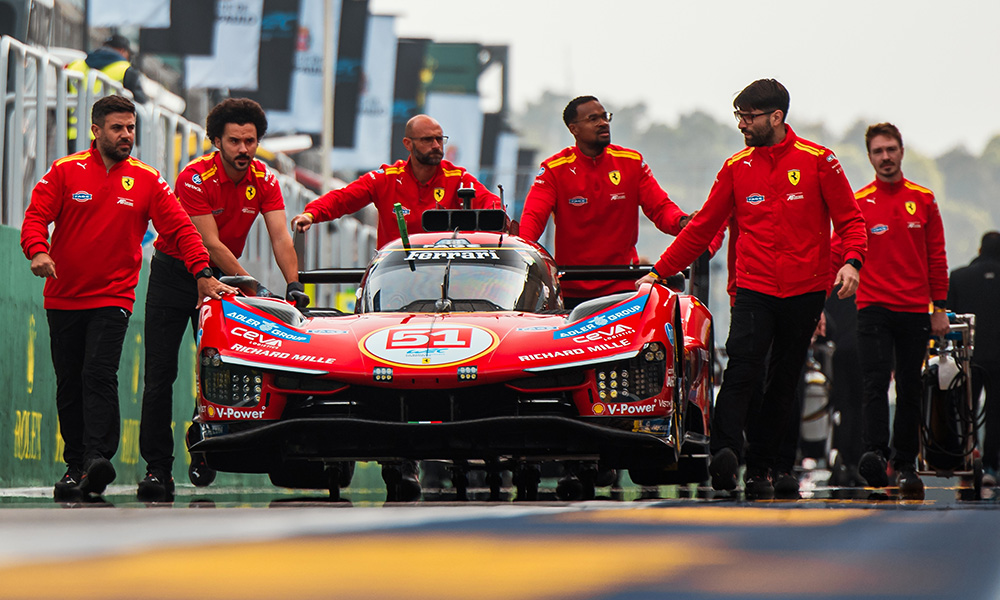
Ferrari AF Corse team manager Batti Pregliasco explained that the prevailing uncertainty has driven teams to establish contingency arrangements for transporting their equipment so they are ready for either outcome.
“I think every team, together with the series organization and DHL, has already put in place a ‘Plan B’ with duplicate material kits,” Pregliasco told Sportscar365 in Brazil, discussing the challenges of navigating a schedule that extends beyond the Lone Star Le Mans and the 6 Hours of Fuji.
“For example, we have sent some gear that will head straight to Fuji while we keep a second kit that will go to Austin and then remain on standby to determine whether we head to Qatar, Bahrain, or Europe because that’s the only safe way by sea freight to operate in both regions without risking port delays,” he noted.
“Of course, it represents a cost and an effort, but we have already talked through and prepared these two plans so that we can make them work.”
The ambiguity surrounding the final two venues also left teams uncertain about the number of points available.
With both Middle Eastern races traditionally running longer distances, extra points are typically on offer for those events.
However, with European races planned for October and November amid cooler conditions, variable weather, and shorter daylight, there is a belief that the ten- and eight-hour formats could be replaced by standard six-hour rounds when staged in Europe.
Other Asian locations might have offered the potential to maintain longer distances, but Pregliasco indicated this would come with its own complications.
“To relocate to places like Sepang or China, you confront the same logistical costs and the risk of transport bottlenecks. If you’re based in Austin, you’d need air freight for the material, and it could get blocked somewhere along the way,” he explained.
“It’s a geopolitical issue that matters more than our immediate task of deciding where to race; safety must be the top priority for everyone.”
“And if we get stuck, as we did this winter with containers stuck in Bahrain and Qatar for testing ahead of the planned season opener, the consequences could mean canceling Qatar, Imola, and Spa and erasing all the work, effort, and investment Ferrari has put in. Protecting the championship’s viability is more important than taking risks.”
Pregliasco added that Ferrari is fond of the two circuits originally slated to close the season, emphasizing that “they’re tracks where we’re always competitive.”
Nevertheless, concluding the campaign in Europe would leave Ferrari with fewer opportunities to claw back points against Toyota and BMW in the Hypercar manufacturers’ standings.