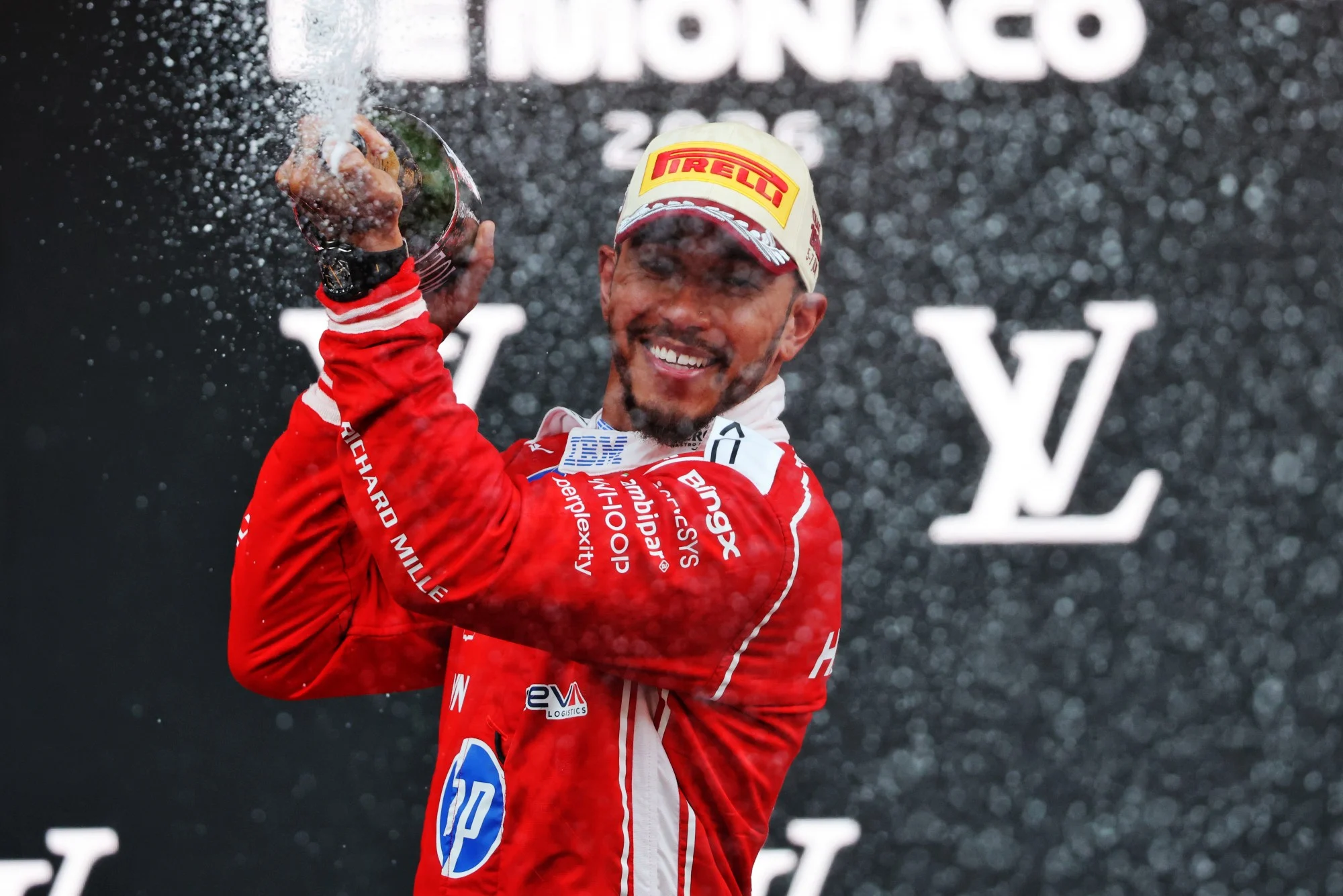
The victory in Barcelona reinforced a trend that has been solidifying over the course of the season. In his second year at Ferrari, Lewis Hamilton leads Charles Leclerc in the main internal indicators and is enjoying his strongest moment since joining the Italian team.
When Lewis Hamilton began his second season at Ferrari, the expectation was to understand how the balance of power within the team would evolve after a first year of living together with Charles Leclerc. The Brit had already shown enough speed to contend for important positions, but there remained the perception that Ferrari continued to be, in many respects, the team built around the Monegasque.
Eight rounds in, that perception began to shift.
The victory in Barcelona was not an isolated event. It represented the most visible milestone of a season in which Hamilton has been consistently outpacing Leclerc and taking on more prominence within the team. The numbers show a clear advantage for the British driver, but what stands out is how it was built: through regularity, execution, and the ability to convert opportunities into results.
More than debating who is Ferrari’s fastest driver, the question becomes another: has Hamilton become the team’s main sporting reference in 2026?
The numbers point in that direction
The first aspect that catches the eye is that the Briton’s advantage is not concentrated in just one area.
In qualifying, Hamilton leads the head-to-head 6-4. The margin isn’t huge, but it is meaningful when considering Leclerc’s reputation as one of the fastest on a single lap. For years, the Monegasque built his image precisely through the ability to extract exceptional laps on Saturdays.
In races, however, the advantage grows. Hamilton leads 5-2 in Sunday head-to-heads, a figure that helps explain his more favorable position within the team. Additionally, the Brit has seven top-10s to five for Leclerc, reinforcing the impression that he has been able to convert opportunities into results more consistently.
The gap between the two doesn’t seem to lie in pure speed. On many weekends, Leclerc showed pace similar to his teammate. What changes is the ability to maximize the available result.
And this has always been one of Hamilton’s greatest virtues throughout his career.
Barcelona was the confirmation of a trend
The victory at the Spanish Grand Prix did not create this narrative. It merely made it impossible to ignore.
From the start of the season, Hamilton had been delivering solid performances and appearing frequently among Ferrari’s frontrunners. Barcelona was the moment when everything clicked. The Brit was competitive throughout the weekend, benefited from the team’s efficient strategy, and secured his first victory with the Italian squad.
The result carried symbolic and sporting weight.
Symbolically, it represented the first major moment of the partnership between Hamilton and Ferrari. Sportingly, it reinforced a trend that had already emerged in internal confrontations. While Leclerc continues to seek a run capable of placing him in the championship contention, Hamilton has been the driver who most often delivers the results the team expects.
This does not mean the Monegasque has become a supporting actor. But it means that, at this moment, Ferrari’s sporting leadership seems to be in the hands of the teammate.
Leclerc’s Challenge
There is also an important psychological aspect to this rivalry.
For years, Leclerc was treated as Ferrari’s present and future. The team invested in the driver, built projects around him, and bet that he would be the one to drive the Scuderia back to world titles.
The arrival of Hamilton changed this dynamic.
For the first time since cementing himself at Ferrari, Leclerc has begun sharing the spotlight with someone who carries roughly the same weight or even more within the Formula 1 structure. And so far, the Brit has managed to capitalize on this rivalry.
This creates an interesting situation for the rest of the season. If Leclerc reacts, Ferrari could have one of the strongest duos on the grid fighting for the top positions. But if the current trend continues, the team may naturally start directing its attention toward the one delivering more results.
It wouldn’t be a political decision. It would simply be a consequence of performance.
Does Ferrari have a new leader?
Perhaps it is still early to assert this definitively.
The season is far from over, and Leclerc has enough talent to reverse any narrative built so far. Moreover, the gap between the two isn’t large enough to end the discussion.
But it would also be hard to ignore what the numbers show. Hamilton leads the qualifying standings. He leads the races. He leads the top-10 appearances. And now he also has Ferrari’s first victory of 2026.
All of this in just eight rounds.
When the season began, the expectation was to see whether Hamilton could quickly adapt to Ferrari, something that did not succeed in 2025. What we are seeing is somewhat different. The Brit has not only adapted but begun to assume the role of reference within the team.
Whether this trend will continue to the end of the championship remains an unknown. But as we approach the Austrian Grand Prix, one conclusion seems hard to dispute: at this moment, Hamilton is winning Ferrari’s most important internal battle.