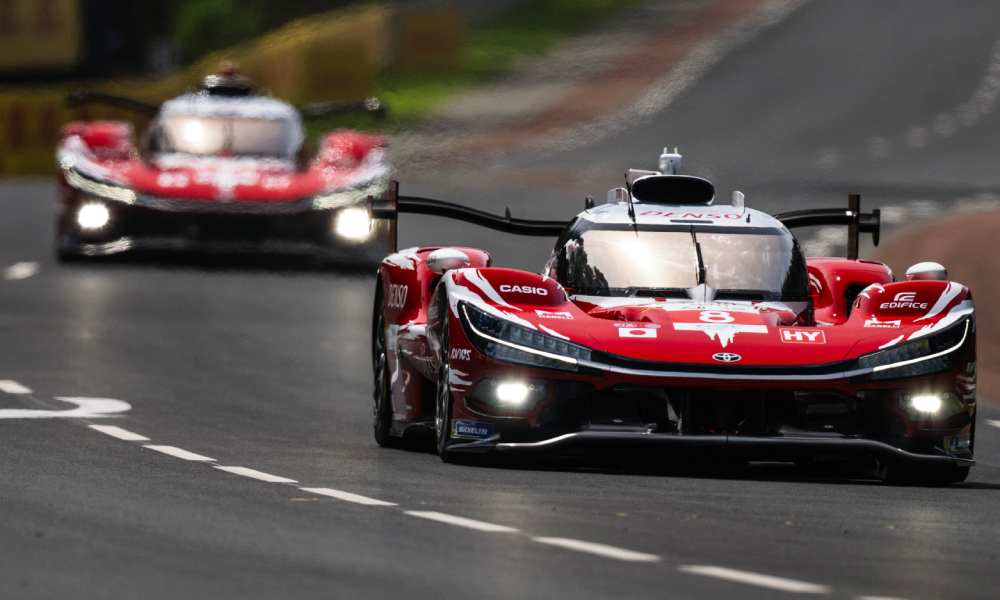
Toyota has admitted that its future in the FIA World Endurance Championship’s Hypercar class could be thrown into doubt if it is forced to abandon the four-wheel drive configuration of the current Toyota TR010 Hybrid in the 2030 regulations.
The FIA, ACO and IMSA revealed an outline of its plans to unify the current LMH and LMDh rulesets into a single platform earlier this month, mandating a rear axle-mounted hybrid system that can be either bespoke or common.
It means that the current LMH configuration of having a front axle-mounted hybrid, to effectively create four-wheel drive, is set to be outlawed.
While Toyota had always made it clear that maintaining the freedom to build its own hybrid system, as opposed to using an LMDh-style spec unit was a red line, the marque’s global motorsport director Masaya Kaji has revealed that scrapping 4WD would also be highly problematic for its continued participation in Hypercar.
“Honestly, this took us by surprise,” Kaji told Sportscar365 when asked for his reaction to the regulations. “We have participated in a lot of meetings up to now, and we believed that no final decision had been reached, yet it was announced in this way.
“What is intended to be achieved with a single platform remains unclear to us. If the objective is to converge on LMDh, it will be very difficult for Toyota.”
“If that is the idea, and we have to give up on using 4WD, we would have to start our development from scratch. For us, that is painful to accept.”
“We are trying to interpret the FIA and ACO’s announcement—are they telling us, ‘build an LMDh’? Perhaps there is another meaning; we don’t know at this stage. We need to understand the nuances to determine if we can accept it or not.”
Kaji explained that Toyota hopes to develop a hydrogen-powered car to take advantage of the new ‘H2 Hypercar’ rules that were also unveiled and are due to come on stream in 2030 at the same time as the new Hypercar rules.
While Toyota will not be alone in having to redevelop its current LMH concept to fit the new rules, he said that the Japanese brand’s desire to race with hydrogen puts it in a unique position, and that it could not commit resources to developing a new two-wheel drive Hypercar concept that does not align with its interests at the same time.
“We want to develop a hydrogen car, and if we decide to commit to that path, then for us we must develop all the systems, the tank, the delivery system,” Kaji said.
“And beyond that, the performance won’t be enough with hydrogen alone, so we also want to use a hybrid system with that.”
“A front-wheel drive system is much more effective than a rear-wheel drive system for energy recovery. So for Toyota, if we converge on rear-wheel drive, it’s very difficult.”
“We need to confirm our direction by the end of this year, and then begin development from the start of next year. We would have to change the configuration of the power unit and all the control systems if 4WD was scrapped.”
“Our hope is to share as much development as possible between a hydrogen Hypercar and a conventional Hypercar. If that is no longer possible, the burden on our budget and engineering resources becomes substantially greater, making it much more difficult for us to justify and sustain both programs.”
“Additionally, for sustainability, we need to pursue energy efficiency with the front motor hybrid system. We cannot go back to the classical [2WD] power train for the future.”
Amid a reluctance on the part of other Hypercar manufacturers to commit to hydrogen, Kaji said he is resigned to Toyota being alone in the ‘H2 Hypercar’ subclass.
An ‘Equivalence of Technology’ is set to be used to balance hydrogen-powered cars against their conventional counterparts, which are set to weigh considerably less, but Kaji expressed doubts that such a system would be truly effective.
“We would like to be there in 2030 with a hydrogen-powered car,” said Kaji.
“Given the current situation, we understand that we may be the only manufacturer pursuing this path initially. That is exactly why we believe it is important to build a broader hydrogen racing community.”
“If every other manufacturer adopts a configuration similar to LMDh, then it would not be a true competition of technologies. That would be difficult for us to accept.”
“As Toyota Motor Corporation Executive Vice President [Hiroki] Nakajima has mentioned, we are also open to supplying hydrogen engines to other teams as a way of helping expand the hydrogen ecosystem in motorsport.”